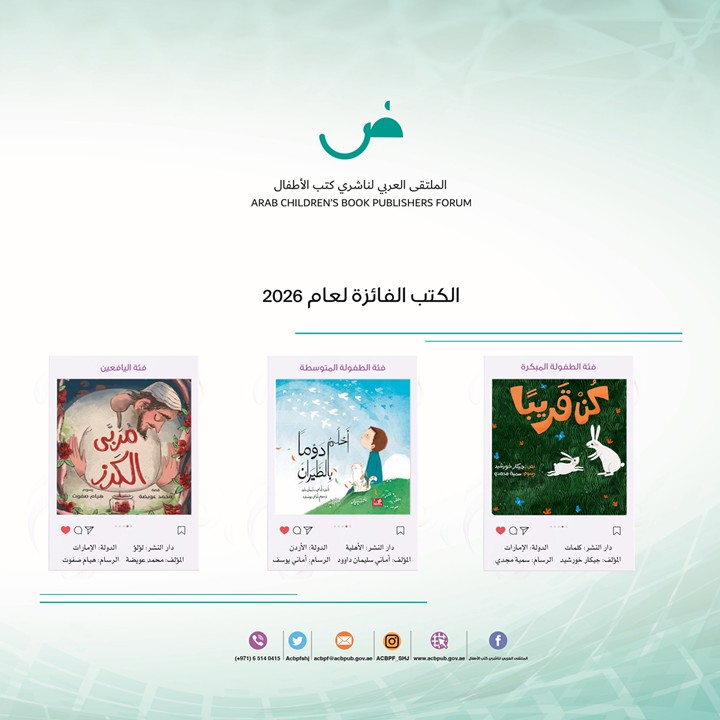
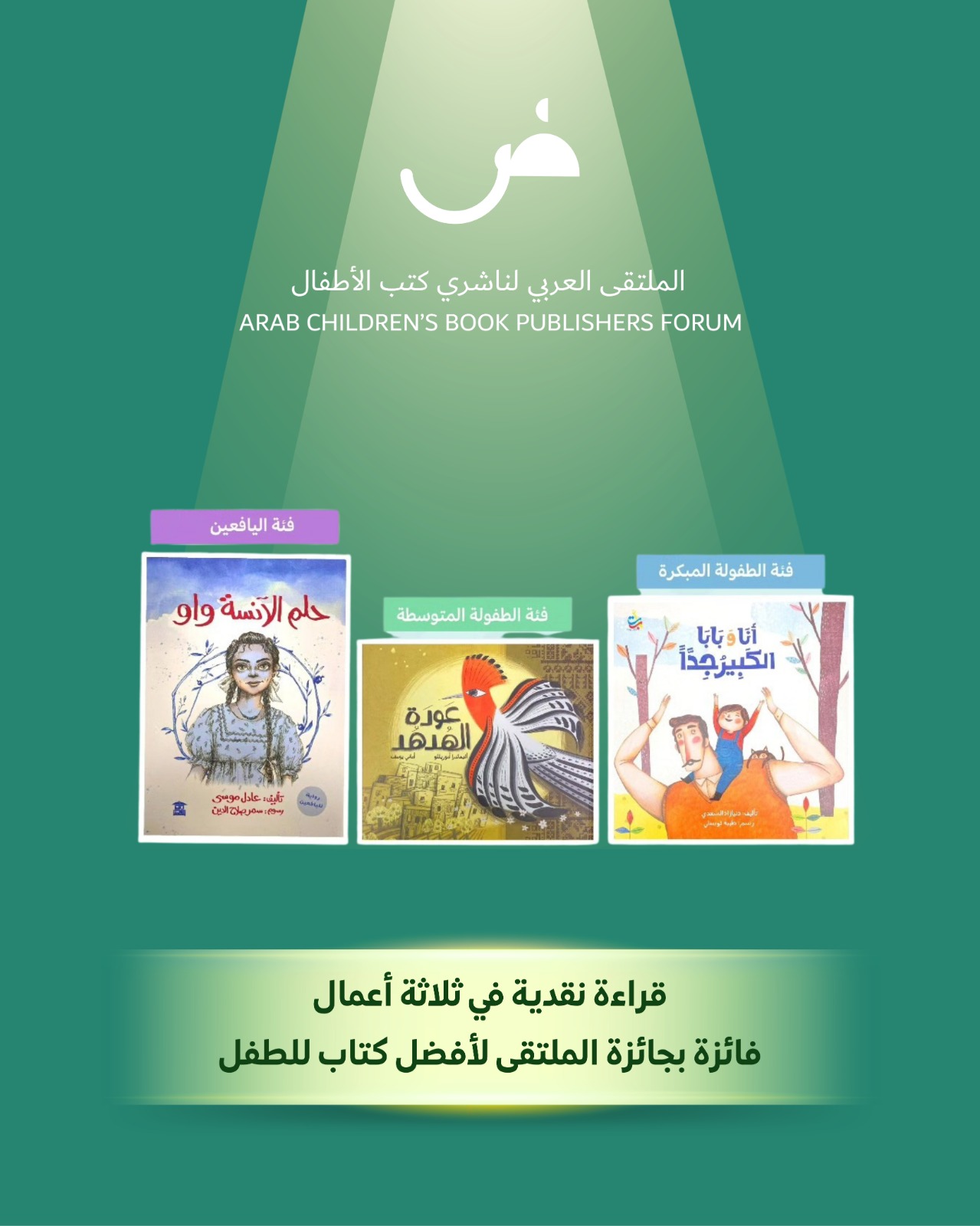
A Critical Reading of Three Award-Winning Works Honored by the Arab Forum Award for Best Children's Book
The following article presents a critical reading of three distinguished works of Arabic children's literature that have received the Arab Forum for Children's Book Publishers Award. Through these readings, the author examines themes of courage, identity, belonging, family, and hope, while offering insightful observations on narrative structure, symbolism, and literary technique. Miss Waw's Dream Miss Waw's Dream is an inspiring novel for young adults set in the community of storytellers—a simplified microcosm of society at large. Many years earlier, the elderly Chief Storyteller had decreed that woman should be forbidden from storytelling, arguing that they were incapable of bearing such a great responsibility. He also believed that women tended to invent new stories, thereby threatening the preservation of traditional tales and the storytellers' mission of safeguarding cultural heritage. According to this decree, the kitchen was the only place suitable for women. For decades, the rule remained unquestioned until the courageous Waw emerged. Inspired by her grandmother's legacy, she believed it was her right to become a storyteller. Although her parents initially tried to dissuade her, she remained steadfast. During the annual Festival of Storytellers, she openly declared her wish to the Chief Storyteller himself—a man feared and respected by everyone. The Chief first attempted to persuade her gently, insisting that storytelling was too difficult for women and incompatible with long-established traditions—traditions that he himself had created. Unmoved by his arguments, Waw purchased a rababa (a traditional one-stringed instrument) and sat in the village square to perform her very first story. Her determination placed the entire community in an uncomfortable position. The novel presents a subtle conflict between tradition and renewal, rigidity and change. Determined to test her resolve, the Chief Storyteller ordered Waw to climb the mountain alone and spend the night inside the Cave of the Covenant. He declared that if she were sincere in her purpose and dreamed of the ancient grandmother of storytellers, she would be officially recognized as one of them. Waw accepted the seemingly impossible challenge without hesitation. She spent the night alone but did not dream of the grandmother. Instead, something unexpected happened. When she descended the mountain the following morning, a star-shaped mark had appeared on her forehead—a symbol that, according to ancient tradition, had once distinguished true storytellers. The Chief Storyteller finally surrendered and proclaimed Waw a storyteller. From my perspective, however, this symbolic ending, which celebrates the rise of Waw as a new storyteller, does not entirely harmonize with the novel's otherwise realistic atmosphere. Throughout the narrative, the author relies on logical dialogue and rational argument. Waw's courage, perseverance, and unwavering commitment to her dream seem sufficient to justify her success without resorting to a supernatural sign, whether in the form of a prophetic dream or the miraculous appearance of a star. After all, her determination had already earned the support of her parents and several members of her family. Her cousin, inspired by her bravery, found the courage to reveal his own secret: he loved cooking rather than storytelling, and the delicious dishes the Chief Storyteller enjoyed every festival had always been his creations, not his mother's as everyone believed. Waw's remarkable courage—especially her lonely ascent of the mountain through darkness, cold, and solitude, carrying a heart filled with stories—was, in itself, enough to establish her as a storyteller. She did not need a miracle that might or might not occur to validate her dream. The Hoopoe's Return The Hoopoe's Return is a brief and seemingly simple story, yet it is emotionally profound and deeply moving. It addresses the themes of displacement, uprooting, exile, and the enduring hope of return. Although grounded in reality, the story is richly woven with symbolism. Ghassan is a cheerful boy who shares his secrets with an orange tree. At the same time, he carries an unspoken fear that the world around him might suddenly change. Yet the story never clearly explains what prompted this fear or what Ghassan had witnessed to make him feel this way. Although his anxiety is later justified by the events that unfold, the narrative leaves its origins unexplained. After a deafening uproar, everyone leaves the village carrying the keys to their homes. Here again, the author leaves the details to the child's imagination: What exactly happened? Why were the villagers forced to leave? While the symbolism clearly points to the events of the 1948 Palestinian Nakba, the narrative does not provide sufficient clarity for young readers unfamiliar with that historical context. Although Ghassan disappears physically from the story, his presence endures through the orange tree that patiently waits for his return. The tree symbolizes his deep roots in the land—roots that can never be severed. Its continued flourishing also embodies the enduring hope that one day he will come back. When autumn arrives, a hoopoe appears in the village. The hoopoe carries profound symbolic significance in Arab and Islamic culture. It is associated with spiritual insight and the ability to perceive truths hidden from others, recalling the Qur'anic verse in Surat An-Naml: "I have come to you from Sheba with certain news." Its arrival in the story functions as a prophecy that Ghassan's return is inevitable, reinforcing the hope already represented by the steadfast orange tree. Notably, the author writes that the trees "fell ill" rather than saying they "died." Illness implies the possibility of recovery, and this is precisely what the hoopoe brings about. Carrying seeds from tree to tree, it scatters them until the "Forgotten Hill" blossoms once again. This description evokes a forgotten cause that inevitably returns to public consciousness, no matter how much time passes. Throughout the story, the orange tree repeatedly wonders why the hoopoe chose her and why it chose the hill. The text states that the bird "continued to ignore her and flew away." In my view, the word "ignore" is not the most appropriate choice here, as it unintentionally diminishes the importance of both the tree and her questions. A gentler expression, such as "it flew away in silence," might have better preserved the story's poetic atmosphere. Everything remains hidden beneath the surface, like seeds lying dormant in the earth, until the right moment arrives. Then the Forgotten Hill blossoms, and Ghassan finally returns, now grown, holding the hand of a little girl named Lamees. Her name evokes the Arabic root meaning "touch," suggesting that the long-awaited return has finally become tangible. The child herself also symbolizes continuity, renewal, and the enduring fertility of the land. Here again, however, time is compressed, and the symbolism seems to suggest that the flourishing trees alone brought about Ghassan's return. The extensive use of symbolism may prove intellectually demanding for young readers who possess little or no knowledge of the Nakba. At the end of the book, the author explicitly refers to Ghassan Kanafani, thereby anchoring the story firmly within the Palestinian context. In my opinion, the narrative could have addressed the issue more directly, without excessive reliance on metaphor. Likewise, the symbol of the house key is inseparable from a specific historical reality—it belongs uniquely to Palestine. The story is heavily imbued with sadness. Some emotional relief might have been achieved by including a charming secret that Ghassan once shared with the orange tree, allowing the memory to resurface upon his return and gently soften the narrative's emotional weight. The language is lyrical, concise, and beautifully crafted. Descriptions such as the oranges being "golden like the stars in the sky" add poetic richness. Yet, since stars are more commonly associated with silver or white light, comparing the oranges to "golden suns" might have created a more vivid and harmonious image. Me and My Very Big Daddy This picture book is intended for children in early childhood. The word Daddy in the title immediately conveys warmth, affection, and emotional closeness, while the description "very big" reflects the child's perception of the father as a figure of strength, security, and admiration. The story follows the everyday experiences of a young child with his father. In the morning, covered in shaving foam, the father resembles a snowman—a humorous image that encourages children to observe the people around them and relate what they see to their own experiences and imagination. The father also carefully grooms himself in front of the mirror, inspiring the child to hope that one day he, too, will be neat and well-presented. As a role model, the father naturally becomes someone the child wants to imitate, and these simple daily rituals remain deeply rooted in the child's memory. When the father returns home from work carrying groceries and household necessities, his strength is shown not merely through physical power but through his dedication to caring for his family and providing for their needs. In the child's eyes, the father is much more than someone who works outside the home; he is many skilled people in one. He repairs broken chairs and leaking taps, paints the walls, and takes care of the family's belongings. Through these everyday acts, the story quietly promotes the values of responsibility, maintenance, and respect for personal property. The child also enjoys moments of play with his father, reminding readers that children's needs are emotional as well as material. Together they race, climb the trees in the garden, and pick fruit. Later, the father is seen reading a book in the evening, offering children a gentle and positive model that encourages reading as a natural part of everyday family life. With every new experience they share, the child dreams of becoming just like his father when he grows up. The story concludes with a delightful reversal: the father wishes he were as small as his child because his large size always gives away his hiding place whenever they play hide-and-seek. This warm and engaging story celebrates the father's role not only as a provider but also as a companion, mentor, and role model. Through simple, familiar moments, it highlights the emotional bond between parent and child and reminds us that the most meaningful lessons are often found in everyday family life.
By Ms. Latifa Buti
Read More